

If you’ve been told you need to pass an “ICC exam” to get licensed, you’ve probably also got questions nobody’s answered clearly: What is ICC? Is this the same as my state license? What happens after I pass?
Here’s what you need to know:
ICC Writes the Test. It Doesn’t Hand Out Licenses.
The International Code Council (ICC) develops and administers electrical and building code exams used by jurisdictions across the country. That’s the whole job — they write the test; they don’t license anybody.
Your local building department or state licensing board is the one that decides whether ICC’s exam applies to you, which version you need, and what to do with your score once you have it. Two candidates can pass the exact same ICC exam and still face different next steps, because it’s the jurisdiction, not ICC, that decides what a passing score is worth. In one jurisdiction, that score might be the last piece of the license application. In another, the candidate may still owe experience hours, fees, or additional paperwork before they’re licensed.
Decoding the Standard Exam Codes
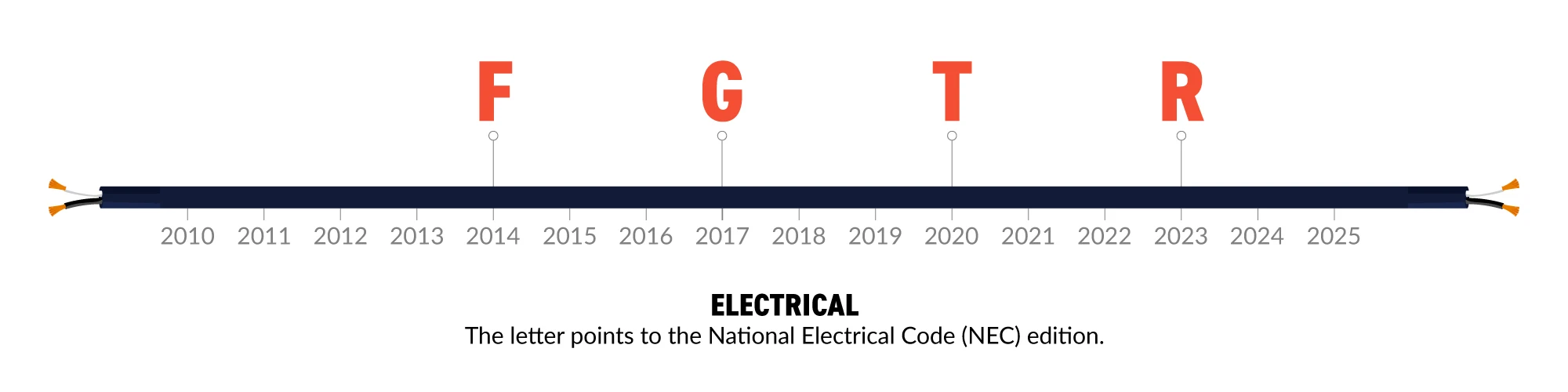
ICC’s standard exam codes follow a simple system: the letter tells you the code cycle, the number tells you the license tier. One important wrinkle: the letter doesn’t point to the same edition year across tracks — electrical and general contractor (GC)/builder exams run on separate code cycles, even when they share a letter.
Electrical — the letter points to the National Electrical Code (NEC) edition:
General/Residential Building Contractor — the letter points to the International Building/Residential Code (IBC/IRC) edition:
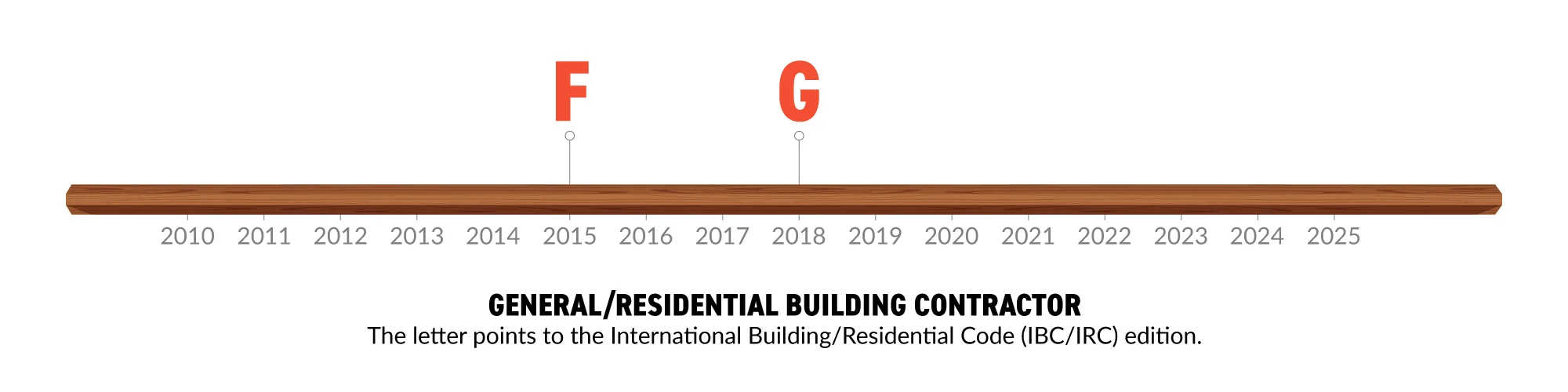
Through November 30, 2026, the F- and G-series are the only series with a GC/builder track. Starting December 1, 2026, the F-series is being retired and the new T-series adds Contractor/Trades exams based on the 2021 I-Codes. Note that “T” means the 2020 NEC for electricians and the 2021 I-Codes for contractors.
The number = which license tier you’re testing for:
Electrical
General/Residential Building Contractor
Curious what the A/B/C codes signify?
They refer to the general scope of work each tier typically covers: (A) construction, remodeling, or repair of any structure; (B) commercial buildings and multi-dwelling buildings up to three stories; (C) residential buildings up to two stories. However, project size and trade limits vary by jurisdiction, so confirm specifics with your local building department before assuming a tier covers your work.
Put them together, and the code tells you exactly what you’re prepping for. A G16 is a Master Electrician exam on the 2017 NEC. An R18 is a Residential Electrician exam on the 2023 NEC. A G12 is a General Building Contractor (B) exam on the 2018 IBC and IRC.
Why the Exam Codes Can Look Different by City
That’s the standard system — but you won’t always see it applied directly. If you’ve compared notes with someone in another state — electrical or GC — you may have noticed you’re not even prepping for something labeled G16 or R18. Some jurisdictions that use ICC exams assign their own local code instead — things like KGD, W16, 211, or 530.
The codes differ. What’s being tested usually doesn’t. Underneath the local naming, jurisdictions are still testing on one of the standard code editions above — the local label just doesn’t show it.
So when you’re figuring out what to study, the question isn’t “what does my city call this exam” — it’s “which edition does my jurisdiction test on.” That’s what determines your prep, not the local code label.
What It Takes to Pass
Depending on your license tier, the scope of what’s covered and the score you need to pass change:

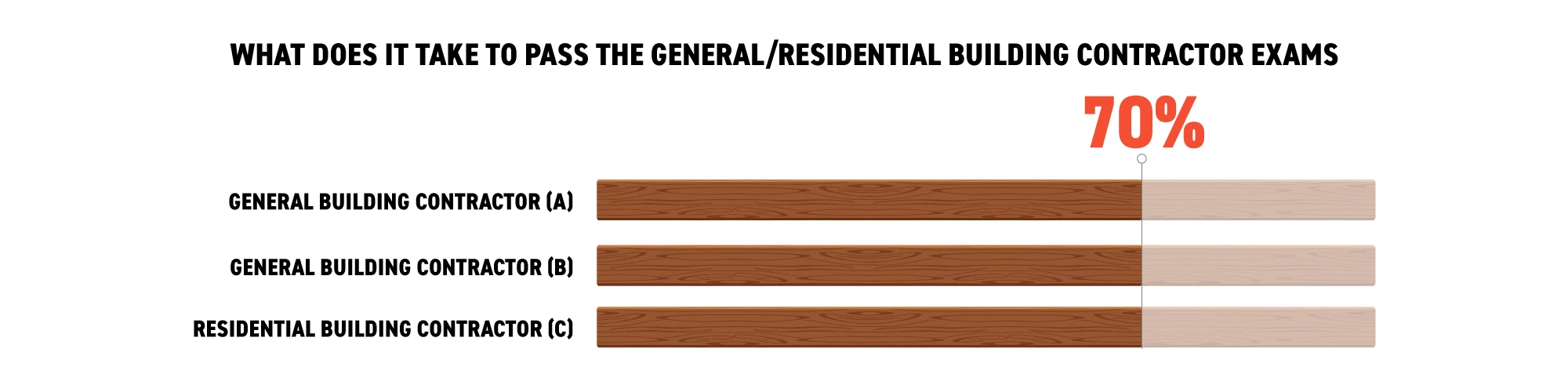
To see the full scope of what content is covered on your exam, check out the ICC exam catalog.
Exams are administered through a third-party testing vendor — typically Pearson VUE, PSI, Prov, depending on your jurisdiction — and all national ICC exams are open-book. That doesn’t mean they’re easy. Open-book exams test how fast and accurately you can navigate the code under time pressure, not how much you’ve memorized. Knowing your codebook cold — tabs, structure, cross-references — matters as much as knowing the content itself.
Before You Register: Pre-Authorization vs. Self-Registration
Not every jurisdiction lets you just book a test date. Some require candidates to be approved by the local licensing board before they can register for the exam, known as pre-authorization. Others allow self-registration, where you schedule directly with the testing vendor with no local sign-off required first.
Here’s what each path looks like:
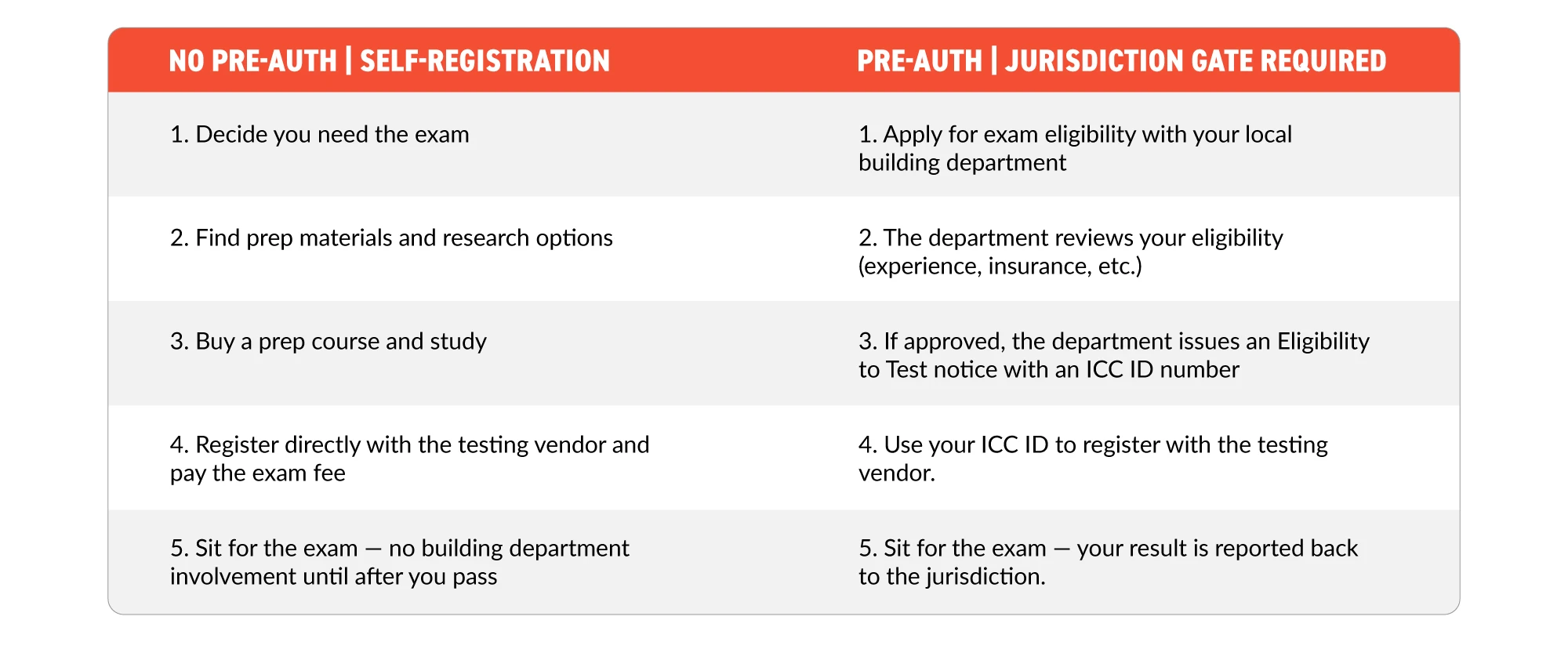
If your jurisdiction requires pre-authorization, build that approval time into your timeline — there’s no published list of which jurisdictions require it, and requirements can vary by license type even within the same jurisdiction. Confirm with your local building department before setting a study deadline around a specific test date.
What Happens After You Pass
Passing your ICC exam gets you a score report. What that score does depends entirely on where you’re getting licensed.
In most jurisdictions, your passing score is submitted to the local licensing authority as one piece of your license application — often alongside experience hours, insurance, fees, or other documentation the jurisdiction requires.
This is also where reciprocity comes in. Some jurisdictions have reciprocity agreements that let an existing license or passing score from one jurisdiction count toward licensing in another, without needing to retest. Reciprocity isn’t universal, and the terms vary by jurisdiction. If reciprocity matters to your situation, confirm directly with the states involved before you assume it’s covered.
Your Next Step to Getting Licensed
Before you book a test date, confirm which ICC exam your jurisdiction uses and which code edition it tests on — a 2017-based G-series review won’t cover what a 2023-based R-series exam expects, even if both get loosely called “the ICC test” in conversation.
MCL builds ICC exam prep around the tier and code edition your jurisdiction tests on — not a generic one-size-fits-all course. Find your exam, and if you’re not sure which one applies to you, an advisor can help you figure it out before you spend a dollar on prep.